Friday, June 7, 2013

The Pros & Cons of Bonded Nylon Thread


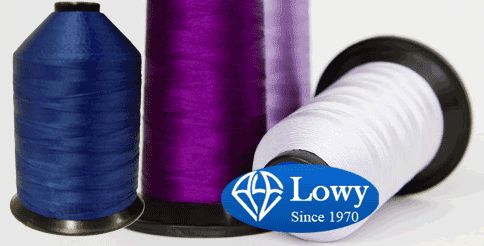
Bonded nylon thread is a wonderful thread to use widely in our daily lives. Developed in the 1930's, bonded nylon is a very resilient thread. When compared to other types of thread, nylon is appreciated because it is extremely strong and flexible.
There are many advantages and disadvantages of nylon thread. On the positive side, bonded nylon thread is coated with a special resin which helps make the thread strong and durable. A middleweight (Size 92) nylon thread has a tensile strength of about 15 pounds. At that strength there are very few people who can break it just by pulling. Nylon thread stretches about 26%. This means that 12 inches of nylon will stretch to 15 inches over time. This is usually good because it lets your seams adjust to movement and changes in temperature. Additionally, nylon thread is lightweight, smooth and does not absorb liquid, which is especially important for clothing applications where underarm seams are prone to weakening because of perspiration.
There are some negative issues with nylon thread, because it tends to get brittle and turn yellow over time. When used for seams on clothing, this issue is likely not a problem because of the overall short lifespan of clothing and the fact that seams are hidden on the inside of a garment. Nylon thread melts when exposed to the high heat of a clothing iron. To avoid fused seams, users should be sure to iron items with a low-temperature iron and with the correct side out, rather than inside out.

Main Uses of Nylon Thread:
Luggage and travel goods
Soft Goods
Outdoor goods and sports equipment
Pet Collars & Leashes
Tie-downs
Cargo Straps & Slings
Harnesses
Leather sewing
Belts
Leather Wear
Furniture Upholstery

Footwear

Tuesday, May 21, 2013

Two Common Types of D Rings


D Rings
D rings, shaped like a letter D, are a type of hardware for a variety of uses. They are available in many different styles, colors, sizes and either plastic or metal. 
Lowy has many different types of D Rings, including metal D rings for heavy duty applications and plastic D rings for light duty applications.
Metal D rings are usually used in securing cargo and vehicles for storage or transport. A common use for metal D rings, including weld on D rings is for trailers as tie down anchors. Metal D ring parts and accessories can help you customize your trailer configuration with load specific trailer tie down anchors. Choosing the right trailer D rings for your application depends on the functions that your trailer required - recessed truck tie down rings won't get in the way of rolling cargo on and off your trailer, rotating anchor rings let you work from multiple angles to fit a variety of cargo, and surface mount D hooks are great for lightweight cargo and vehicles - easy access to the folding D ring make quick work of loading and unloading your trailer. 
For light-load applications such as clothing, backpacks and luggage, D-rings are mostly made of plastics such as nylon may be used, as they weigh less and are impervious to rusting. They can be sewn to almost anything including backpacks and clothing.
When it comes to the use of plastic D rings, dog collars, double D-ring belts, and utility straps are at the top of the list. On the utility strap, D-rings are attached to the end to use as an anchor strap.  Dog collars have the D-ring of course, so you can attach the leash to it with ease.  Two D-rings are sewn onto the end of the webbing or strap to make a cool looking belt, but can also double as a utility strap.

Wednesday, May 15, 2013

Hook Straps Types


Lowy has two kinds of hook straps for your best choice. They are flat hook straps and wrist hook straps.
A flat hook strap is a strap webbing with flat hooks for the end hardware. One strap utilizes a Flat Hook sewn on one end and a Cam Buckle sewn on the opposite end. The second strap to the set utilizes a Flat Hook sewn on one end. Pull open the Cam Buckle and feed in the loose end of the strap after putting the hooks in right place. It is used for attachment to whatever you want to secure, hold down, etc.. It also works very well as a trunk strap. The vinyl coated flat hooks don't mar your paint job and hold well on the trunk lip. These are good replacement straps for trunk mounted bike racks.
Wrist hook straps offer solid grip support on many different kinds of lifts. The powerful wrist hook straps can be attached to the bar much easier than regular straps. All you do is hook them under the bar, handle and lift. Adjustable Velcro wrist strap is padded with neoprene for comfort and firm fit. With heavy nylon webbing and strong construction, it is great for shrugs, rows, deadlifts, etc.. Keep a super secure grip even when fatigued with the power surge wrist hook straps.

Monday, April 8, 2013

Lowy: Replace a Plastic Buckle for the Backpack

Lowy: Replace a Plastic Buckle for the Backpack: You are hinking in the mountains with your friends and unfortunately, a key plastic buckle goes from your backpack, what should you do? I...

Wednesday, April 3, 2013

Replace a Plastic Buckle for the Backpack


You are hinking in the mountains with your friends and unfortunately, a key plastic buckle goes from your backpack, what should you do?

It's time to replace your plastic buckle! There a are two ways to fix your plastic buckle. One is quick fix which requires a replacement plastic buckle, a pocket knife or lighter.

Steps for quick fix:
1. Match your buckle. The best match, of course, is the same exact type as the original. If there's no replacement buckle, you can use a primarily decorative matching buckle somewhere else on the bag instead, maybe it's your best bet.

2. Check the broken plastic buckle to find the plastic bar which the webbing is looped over. Cut a small gap carefully in the center of the same bar on the replacement buckle.

3. Make the nylon loop through the gap in the bar to attach the plastic buckle to the webbing.

The other way is sewn fix which requires a replacement buckle, Seam ripper, heavy-duty thread and needle.

Steps for sewn fix:
1. Use a seam ripper to remove the stitches to free the old buckle.

2. Fold the end of the webbing through the new buckle and fold the webbing over on itself.

3. Thread the needle and sew both layers of the webbing together.

4. To make the plastic buckle strongly attached, sew almost all the way across the strap, up one edge a little, back across the strap in the other direction, then back down to where you started, forming a rectangle. Then sew an "X" inside the rectangle, connecting the corners. Tie off the last stitch and cut the thread.

Anyway, quick fix is simple and fast while the sewn fix is strong and permanent.

New plastic buckles are widely available and inexpensive. Lowy's full line of plastic fasteners include side release buckles, plastic buckle, double bar buckles, cord locks, d-rings and loops.


Sunday, March 10, 2013

Comparisons for Nylon Webbing, Polypro Webbing, Polyester Webbing


As all of us know, webbing is widely used in our daily lives. In terms of webbing types, there are nylon webbing, Polypropylene Webbing, cotton webbing, polyester webbing, etc. Now I would like to have a discussion about the differences between cotton webbing and nylon webbing.
Nylon webbing is the most abrasion resistant of all the webbing types. It is flexible, strong, durable, and with a breaking strength from 1,400 lbs. to 5,500 lbs., depending on the thickness.
Nylon webbing is usually used in straps, leashes, belts, clothing, packs, bags, safety harnesses, tie-downs, slings, cargo nets, boat rigging, dog collars and restraints. It also suitable for luggage straps, backpacks, belts and handbags. For instance, nylon webbing is used as the core of our fabric-covered designer dog collars and leashes to make sure our family pets are safe.
Polypropylene webbing, also known as polypro webbing, is waterproof and UV resistant, but not as strong as nylon webbing. Both nylon webbing and polypro webbing have the same melting point of 300 degrees. The easiest way to tell nylon from polypropylene is to toss a short length of the material in water. Nylon will not float but Polypropylene will float on water.
Polypropylene webbing is great for outdoor applications. It is available in 2 styles: Heavyweight, and Lightweight. The lightweight polypropylene webbing commonly used for bags, sporting goods, luggage, personal flotation devices, backpacks, children's products, and general purpose straps. While the heavyweight polypropylene webbing commonly used for bags, straps, handles, reinforcements, sporting goods, luggage, backpacks, and general purpose straps.
Polyester webbing is often used for Cargo tie-downs, slings, climbing straps, seat belt and bag handles. It is strong and high abrasion resistant. Unlike nylon webbing’s stretch, it is UV light-resistant and will not rot or mildew. The break strength for polyester webbing ranges from 1,500 lbs. to 10,000 lbs..
Source from www.lowyusa.com

Friday, December 30, 2011

LowyUSA Webbing Sample

Lowy USA offers a large sample kit,including webbing, zippers, hook and loop, plastic hardware, elastics, para-gear, a very impressive metal hardware lineup, and more.
Also, Lowy USA has a great webbing type and color selection including some of the harder to find webbings such as scuba and seatbelt types.
Get the sample anytime via the website: www.lowyusa.com